


Surviving the 3 PM Heat When Your Vents Suddenly Blow Warm Air
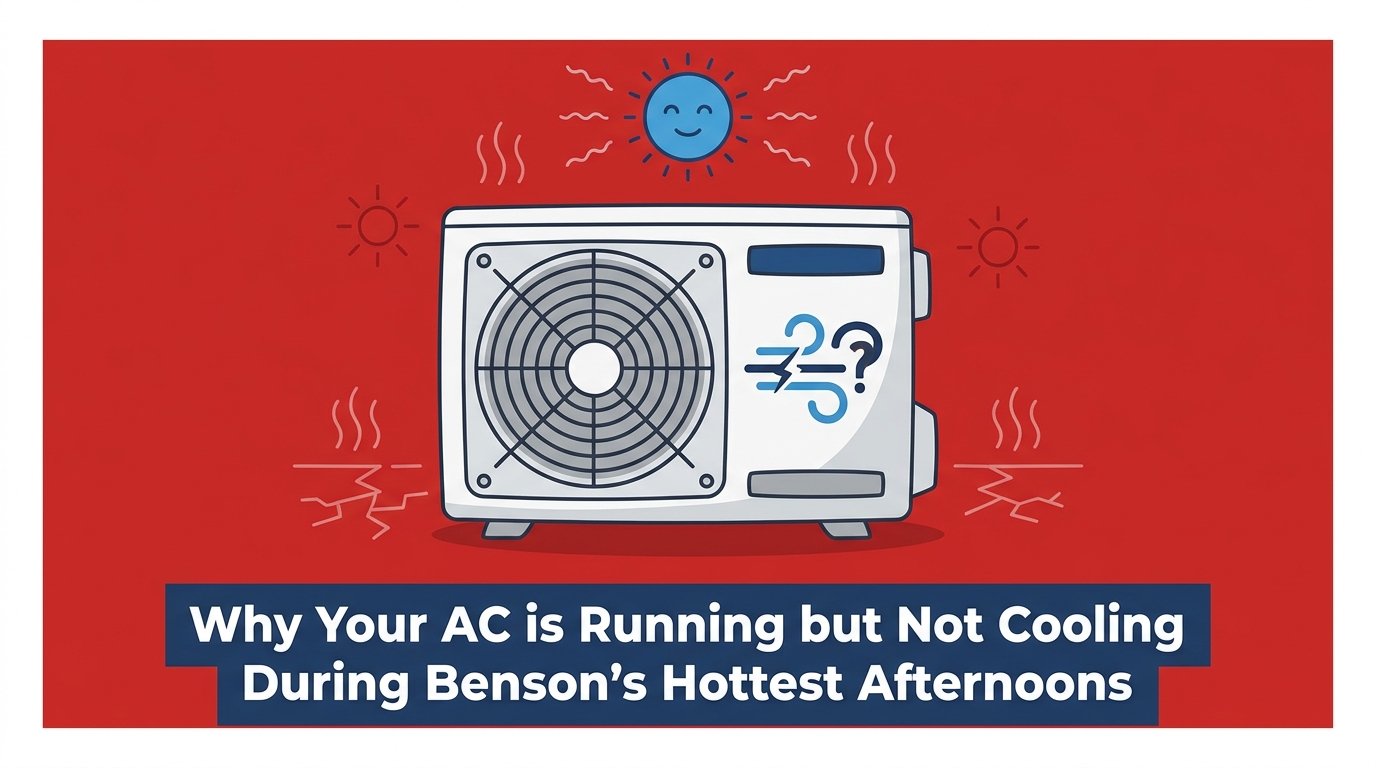
When the July afternoon peak heat (3 PM) strikes, you rely on your cooling system to provide an immediate escape from the sun. If you walk inside only to feel lukewarm air pushing through the vents, you are likely wondering why your AC is running but not cooling during Benson's hottest afternoons. That sinking feeling of dread is completely understandable, especially when the indoor temperature starts climbing by the minute. However, as our team at All American Air frequently reminds homeowners, feeling warm air coming from your supply registers does not automatically mean your entire system is dead or requires a massive replacement.
To get your home comfortable again, you need to know how to navigate this specific problem. While our professional Air Conditioning services can pinpoint the exact failure, understanding the basics of your system helps you triage the issue before our technicians arrive.
Most central cooling systems are split into two main parts: the indoor air handler (which circulates air through the house) and the outdoor condenser (which actually removes the heat). When your vents are blowing warm air, it simply means the indoor fan is doing its job, but the outdoor unit has stopped cooling the air. In our experience working through extreme summer heatwaves, we consistently see this disconnect trace back to one of two primary culprits: a sudden electrical failure or a mechanical breakdown.
Here is the good news: many of these mid-afternoon failures are highly specific to extreme weather stress and can be resolved without replacing the whole unit. By safely observing a few key signs around your home, you can determine what type of failure you are dealing with and take the right steps to protect your equipment from further damage.
Why Extreme Summer Heat Pushes AC Components Over the Edge
To understand why your cooling system suddenly gives up at the worst possible time, you have to look at the environmental stress it faces. With summer temperatures regularly exceeding 100°F in Benson AZ, our technicians see firsthand how outdoor units operate in a state of near-continuous thermal overload. An air conditioner does not actually "create" cold air; it absorbs heat from inside your house and pumps it outside. When the outside air is already baking hot, the system has to work exponentially harder to reject that heat into the atmosphere.
The Physics of Thermal Overload
As ambient temperatures rise, the pressure inside your system's refrigerant lines skyrockets. This high head pressure forces your compressor—the heavy-duty motor sitting inside the outdoor cabinet—to draw significantly more electrical current just to keep pumping. At the same time, the metal cabinet housing these components is absorbing direct solar radiation. The combination of internal electrical heat and external solar heat creates a punishing environment for sensitive parts.
Assuming you have already checked the basics—like ensuring your air filter is clean and your thermostat is set correctly—the extreme heat is likely attacking the system's weakest links. Electrical components, which rely on internal fluids and delicate wiring to store and transfer energy, literally begin to bake. Mechanical connections, which expand and contract with temperature swings, are pushed to their physical limits, often turning minor weaknesses into major failures.
This is precisely why these breakdowns happen in the mid-afternoon. The system has likely been running continuously since mid-morning, building up internal heat that cannot dissipate fast enough. Eventually, a component reaches its thermal threshold and fails, leaving the indoor fan running while the outdoor cooling process stops entirely. If you find yourself in this situation, reaching out to our team for professional AC Repair in Benson is the safest way to restore your system's functionality.
Suspect #1: The Dual-Run Capacitor (The Most Common Culprit)
If your system fails during the July afternoon peak heat (3 PM), the most statistically likely cause we encounter on our Benson service calls is a blown dual-run capacitor. To understand why this happens, it helps to know what a capacitor actually does. You can think of the dual-run capacitor as a massive, heavy-duty battery that stores electrical energy. Your outdoor compressor requires a massive jolt of electricity to start up—often three to six times more current than it needs to simply keep running. The capacitor delivers that initial surge of power and then provides a continuous, steady flow of electricity to keep the compressor and the outdoor fan motor spinning smoothly.
How Heat Destroys Capacitors
Capacitors are filled with a dielectric fluid that helps them store electrical charges while managing internal temperatures. However, when the system runs constantly in 100-plus degree weather, that fluid can overheat, boil, and expand. When this happens, the top of the capacitor swells outward, breaking the internal connections. The moment the capacitor fails, the compressor loses its power source and shuts down.
Because the indoor air handler is on a completely separate electrical circuit inside your house, it has no idea the outdoor unit has failed. The indoor fan keeps running, blowing air over coils that are no longer cold, which is exactly why you feel warm air coming from the vents.
Listen for the Tell-Tale Buzz
You can often diagnose a failed capacitor using just your ears. If you walk outside to the condenser unit, you might hear a distinct, rhythmic humming or buzzing sound coming from inside the metal cabinet. This is the sound of the compressor trying to pull electricity to start, but failing because it lacks the necessary jolt from the capacitor. You may also notice that the outdoor fan blades are completely still, even though the indoor unit is blowing air.
Fortunately, replacing a capacitor is a straightforward repair for a qualified technician. Catching a weak capacitor before it swells and pops is one of the primary benefits we emphasize when homeowners schedule routine AC maintenance services with us before the peak summer season begins.
Suspect #2: A Catastrophic Refrigerant Leak
While a capacitor failure is an electrical issue, the second major cause of warm air is a mechanical failure: a severe refrigerant leak. Refrigerant is the lifeblood of the entire cooling process. It is the chemical compound that cycles through your system, absorbing heat from your indoor air and releasing it outside. If your system lacks refrigerant, it loses its ability to transfer heat, meaning the indoor fan will simply circulate warm house air back into your living spaces.
Understanding the Closed-Loop System
One of the most common misconceptions our team at All American Air hears from homeowners is that cooling systems "use up" or consume refrigerant over time, like a car consumes gasoline. This is completely false. An air conditioner is a closed-loop system. If the refrigerant level is low, it means there is a physical hole, crack, or compromised joint somewhere in the copper lines or coils. In the extreme heat of Benson AZ, the high operating pressures can force a tiny, unnoticeable leak to rupture completely, dumping the remaining refrigerant into the atmosphere.
The Ice Warning Sign in 100-Degree Weather
A refrigerant leak behaves very differently from a capacitor failure. When a capacitor dies, the compressor stops running. When you have a leak, the compressor often continues to run, desperately trying to pump a fluid that is no longer there. As the refrigerant level drops, the pressure inside the indoor evaporator coil drops with it. This causes the temperature of the remaining refrigerant to plummet below freezing.
The moisture in your indoor air then hits this freezing coil and turns instantly to ice. If you look at the copper pipes running from your outdoor unit into your house, you might see them completely encased in thick, white ice—even when it is over 100 degrees outside. This ice acts as an insulator, blocking the air from touching the cold metal, which results in warm air blowing from your vents.
Finding and sealing these leaks requires specialized diagnostic equipment. Whether you have a traditional central unit or utilize highly efficient Mitsubishi Electric Ductless VRF systems, fixing the physical leak is mandatory before our technicians can safely add any new refrigerant to the system.
Hands-Off Diagnostics: Capacitor vs. Refrigerant Leak Symptoms
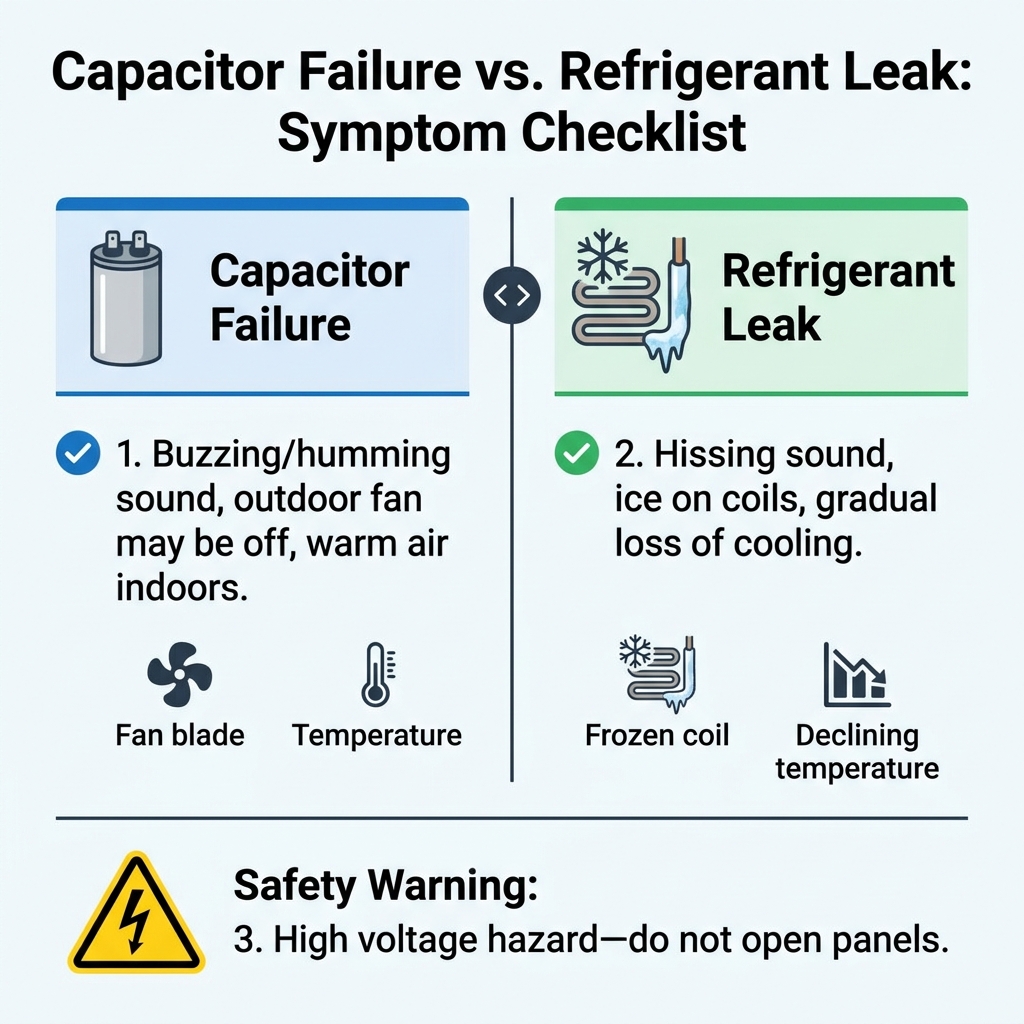
When you are sweating in your own living room during the July afternoon peak heat (3 PM), you need to figure out what is happening quickly. You can perform a safe, hands-off diagnostic check just by looking and listening. Strong warning: Never remove the metal access panel on your outdoor unit to check a capacitor yourself. These components store lethal amounts of high-voltage electricity, even when the main power is turned off.
Instead, use this simple visual and auditory comparison to identify the most likely culprit while you stand safely next to the unit:
• Outdoor Fan Motor — Signs of a Blown Capacitor: Fan blades are completely still or struggling to turn. — Signs of a Refrigerant Leak: Fan is usually spinning normally, blowing unheated air.
• Auditory Clues — Signs of a Blown Capacitor: A distinct buzzing or humming sound every few minutes. — Signs of a Refrigerant Leak: A faint hissing or bubbling sound near the copper lines.
• Visual Inspection — Signs of a Blown Capacitor: No visible changes to the outside of the copper pipes. — Signs of a Refrigerant Leak: Thick frost or solid ice building up on the larger copper pipe.
• Cooling Decline — Signs of a Blown Capacitor: Sudden failure; system worked perfectly, then blew warm air instantly. — Signs of a Refrigerant Leak: Gradual failure; system ran longer and longer before blowing warm.
By identifying these specific symptoms, you can provide exact details to our technicians, ensuring we arrive with the right parts and equipment to handle the job immediately.

Protecting Your Compressor: Why You Must Turn the System Off
If you determine that your system is suffering from either a bad capacitor or a refrigerant leak, the very first thing you must do is walk to your thermostat and switch it to the "OFF" position. Letting an air conditioner run when it is blowing warm air is one of the most destructive things you can do to the equipment, especially in Benson AZ where the heat provides no relief.
The Danger of "Letting It Run"
If the capacitor has failed, the compressor will continually try to start itself every few minutes. Because it cannot turn over, it draws massive amounts of locked-rotor electrical current, which rapidly overheats the internal motor windings. While most compressors have an internal thermal overload switch that shuts them down when they get too hot, repeatedly tripping this switch will eventually burn out the motor entirely. You do not want to turn an inexpensive capacitor replacement into a catastrophic compressor failure.
Likewise, if you have a refrigerant leak, letting the system run can cause "liquid slugging." The compressor is designed to pump vapor, not liquid. If the pressure drops and the refrigerant cycle is disrupted, raw liquid can flow backward into the compressor, destroying the internal valves instantly. Furthermore, running a frozen system forces the indoor blower motor to push against a solid block of ice, which can easily burn out the fan motor.
When you call our dispatchers, be specific. Tell them, "My system is blowing warm air, and the outdoor unit is buzzing but the fan isn't spinning," or "I see ice on my outdoor pipes." This detailed information helps our technicians prepare. Working with our trustworthy local team ensures you get honest diagnostics. Our reputable technicians will accurately diagnose a blown capacitor and replace that specific part, rather than using the failure as an excuse to push for a full AC installation in Benson when it isn't necessary.
Frequently Asked Questions About AC Cooling Failures
Why is my AC running but not cooling?
The indoor fan is circulating air, but the outdoor compressor (which actually cools the air) is either not running due to an electrical failure or lacks refrigerant to absorb heat. Because the indoor blower is on a separate circuit, it continues to push air through your ductwork. Without the outdoor unit actively removing heat, that air remains at room temperature, making it feel warm as it exits the vents.
How do I know if my AC capacitor is blown?
You may hear a buzzing or humming sound from the outdoor unit, the outdoor fan might not spin, and the air coming from your indoor vents will be warm. These symptoms occur because the compressor and fan motors are starved of the electrical jolt they need to start. If you look down through the top grate of the outdoor unit, you might even see that the cylindrical capacitor looks swollen or bulging at the top, though you should never attempt to touch it.
What are the signs of a freon leak in a home AC?
Common signs include ice building up on the refrigerant lines or indoor coil, a faint hissing sound, and a gradual decline in cooling power before it starts blowing completely warm air. You might also notice that your system has been running for much longer cycles than normal over the past few weeks. Because a leak lowers the internal pressure, the system loses its ability to transfer heat efficiently, resulting in frozen components and a hot house.
Can a bad capacitor cause the AC to blow warm air?
Yes. If the capacitor fails, the compressor cannot start. The indoor fan will continue to blow air over coils that aren't being cooled, resulting in warm air at the vents. The thermostat tells the indoor fan to run based on the temperature inside the house, so until you manually shut the thermostat off, the system will keep circulating unconditioned air.
Should I pour water on my AC unit to cool it down?
No. While hosing down a dirty condenser coil can help efficiency during normal operation, pouring water on a unit experiencing an active electrical or mechanical failure will not fix a bad capacitor or a refrigerant leak, and can be highly dangerous. If the system is suffering from an electrical fault, adding water introduces a severe shock hazard. Always turn the system off at the thermostat and wait for a professional assessment.
Get Fast, Honest Diagnostics to Restore Your Comfort
When the temperature inside your home is rising rapidly, a fast response is absolutely critical. Heat exhaustion can set in quickly in Benson AZ, making a broken air conditioner more than just an inconvenience—it becomes a safety concern. However, panicking and guessing at the problem often leads to running the system longer than you should, which only causes more expensive damage to the compressor.
Accurate diagnostics are the key to saving money and restoring your peace of mind. By noting the specific auditory and visual signs of failure, you empower our technicians to work faster and more effectively. At All American Air, we are committed to providing fast, local emergency response in Benson with an absolute dedication to honest repairs. If it is just a blown capacitor, that is exactly what our team will fix. Turn your thermostat off, document what you hear and see, and schedule an inspection with an expert who understands the urgency of getting your home cool again.
Other Blogs

•WHY US
Why Homeowners Choose Us for custom HVAC work
Ann N.
While it was expensive to replace my HVAC I loved with with and They delivered when promised and were very diligent about making sure I understood how the system operated. The knowledge level was SO MUCH HIGHER than anyone else I had received a quote from. I would highly recommend them for HVAC replacement.
Ed T.
americanairaz was very professional and did a thorough job on the installation as well as the annual maintenance check. I would highly recommend All American Air to anyone.
Renaye F.
Great service, professional and affordable company. Very knowledgeable and also took the time to explain everything in detail. Which I appreciated very much. Would definitely recommend.
John C.
First class shop. Very clean install ,would recommend to a friend. Excellent equipment,Mitsubishi is number one in industry.and most efficient seer rating.thank you

Read More Blogs
Explore the world of creative writing and discover how words can paint vivid pictures in the minds of readers.