


The Truth About "Quick Fix" Refrigerant Top-Offs
A persistent myth among homeowners is that air conditioners naturally consume a small amount of Freon over time, and a simple recharge is all it takes to get an aging unit through another hot season. The reality of why we advise against patching refrigerant leaks on systems over 12 years old comes down to the fundamental physics of your equipment. Air conditioning is a sealed, closed-loop system. If it is low on refrigerant, there is a physical hole in the copper tubing allowing it to escape.
During peak July summer heat, a system that suddenly stops blowing cold air creates an immediate, uncomfortable situation. The temptation to request a quick refrigerant recharge just to get through the season is entirely understandable. However, based on our team's first-hand field experience at All American Air diagnosing hundreds of aging units across Benson, patching an old system is merely a temporary band-aid that ultimately wastes your resources. A top-off does not fix the underlying structural failure of the metal.
When you are looking for comprehensive air conditioning services or reliable AC repair in Benson, it is vital to understand the mechanical reality of your equipment before authorizing a temporary fix. A quick patch on a severely degraded system sets a trap that almost always leads to another breakdown just days or weeks later.
The Physics of Failing Copper Coils in Older Systems
To understand why a patch fails, we have to look at the scientific reality of how refrigerant lines and evaporator coils degrade over time. These components are predominantly manufactured from copper. While copper is an excellent conductor of heat, it naturally deteriorates after a decade of continuous exposure to moisture, chemicals, and mechanical stress. By the time a system is 12+ years old, the copper is physically thinner and weaker than the day it rolled off the assembly line.
The core problem: The metal simply lacks the structural integrity to hold high-pressure refrigerant. When our technicians inspect these older coils in the field throughout our service area, we are not looking at a single, isolated puncture caused by a stray nail. We are looking at widespread, systemic degradation of the entire coil surface.
Understanding Formicary Corrosion
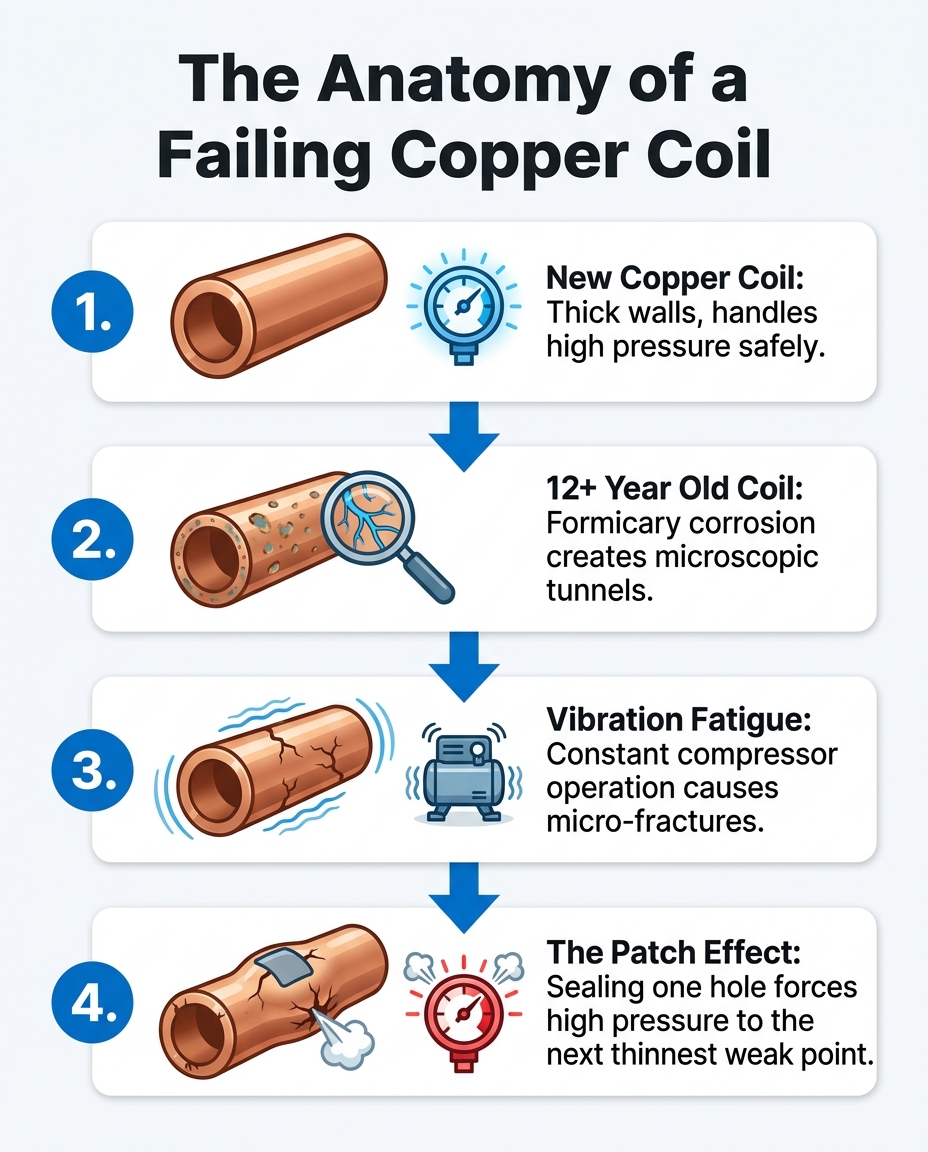
The primary culprit behind this degradation is a chemical process known as formicary corrosion. In layman's terms, this is a microscopic reaction that eats away at the copper from the outside in, creating tiny, ant-nest-like tunnels through the metal walls.
This corrosion is fueled by common household Volatile Organic Compounds (VOCs). Everyday items inside your home—such as hairspray, cleaning supplies, air fresheners, and even off-gassing from new carpets—release microscopic chemicals into the air. When your AC pulls this air across the cold, wet indoor evaporator coil, those chemicals mix with the condensation. Over a decade, this acidic moisture slowly carves microscopic pathways through the copper tubing.
The Impact of Thinning Metal
Alongside chemical corrosion, aging systems suffer from vibration fatigue. The constant rumbling of the compressor kicking on and off thousands of times creates micro-stress fractures in the metal joints.
Think of the copper lines like a worn-out balloon that has been inflated and deflated repeatedly. The material stretches, thins, and loses its elasticity. A pattern we see often is that a patch on this thinned metal is structurally unsound because the surrounding material is too fragile to support the repair.
• New Copper Coil — Wall Thickness: Factory standard (thick) — Pressure Tolerance: Easily handles high pressure — Failure Risk: Extremely low
• 12+ Year Old Coil — Wall Thickness: Paper-thin, compromised — Pressure Tolerance: Struggles under normal load — Failure Risk: Extremely high (imminent)

The "Whack-a-Mole" Reality of Patching Multiple Leaks
When a homeowner requests a repair on a leaking 12+ year old system, the procedure involves locating the leak and brazing it. Brazing requires heating the copper with a torch and melting a silver solder over the hole. However, applying intense torch heat to paper-thin, corroded copper often melts the surrounding metal, making the hole even larger.
Even if the technician successfully seals the initial hole, the physics of a closed-loop system guarantee that the repair will not last. This is a frustrating reality our team sees week after week during July heatwaves: patching a degraded coil is essentially a game of whack-a-mole.
Why Pressure Finds the Weakest Link
Your air conditioner operates under immense internal pressure to circulate refrigerant between the indoor and outdoor units. When a system has a leak, that internal pressure drops. Once a technician patches the hole and recharges the system with fresh refrigerant, the factory-standard high pressure is instantly restored.
Because the entire coil has been thinned out by a decade of formicary corrosion, restoring that high pressure immediately stresses the rest of the compromised metal. The newly restored pressure simply seeks out the very next microscopic weak point.
What happens after a patch on an old unit:
• Immediate stress transfer: The pressure bypasses the strong silver-solder patch and attacks the thin copper right next to it.
• Secondary blowouts: A brand-new leak often forms just inches away from the original repair within days or weeks.
• Wasted refrigerant: The expensive refrigerant you just paid to have added leaks right back out into the atmosphere.
• Compressor damage: Running the system repeatedly on low refrigerant overheats and eventually destroys the compressor.
While routine AC maintenance can extend the life of a healthy system by keeping coils clean and reducing strain, no amount of preventative care can reverse the systemic metal degradation that has already occurred in a dozen-year-old coil.
How Continuous Summer Operation Magnifies System Stress
The physical degradation of an aging AC unit is severely compounded by our local climate. In mild coastal environments, a patched leak might hold for a season because the system only runs a few hours a day. Here in Benson, the reality is vastly different. In our years of keeping local homes cool, we've seen firsthand how Benson's extreme summer heat puts immense, continuous pressure on aging AC units, accelerating wear and making reliable cooling a safety necessity rather than a luxury.
When ambient outdoor temperatures climb well above 100 degrees, the physical demands on your air conditioner skyrocket. The compressor is forced to run longer and harder, often operating continuously for 12 to 16 hours a day just to maintain a livable indoor temperature.
The Strain of Peak Cooling Demands
Operating an air conditioner in 85-degree weather produces a relatively moderate head pressure inside the refrigerant lines. However, operating that same system in 105+ degree heat drastically increases the internal operating pressure.
This continuous, high-pressure operation maximizes the physical stress on the copper lines for hours on end. Furthermore, the constant cycling causes thermal expansion and contraction. As the thin, brittle copper heats up and cools down, it expands and shrinks, which rapidly weakens patched joints. A patched leak on a 12+ year old system in Benson AZ is operating on borrowed time, and a sudden catastrophic blowout during a heatwave poses a serious risk to your family's comfort and safety.
The R-22 Phaseout and Regulatory Realities
Beyond the physical impossibility of permanently patching degraded copper, there is a significant regulatory hurdle to servicing equipment of this vintage. Systems that are 12+ years old almost exclusively rely on R-22 refrigerant, commonly known as Freon.
In 2020, the Environmental Protection Agency (EPA) enacted a complete ban on the production and import of R-22 in the United States due to its ozone-depleting properties. Because it can no longer be manufactured, the only available R-22 is reclaimed and recycled from older, decommissioned units.
Why Sourcing Older Refrigerants is a Dead End
The scarcity of reclaimed R-22 makes it an increasingly poor long-term investment for any homeowner. Pumping a scarce, obsolete chemical into a system that is guaranteed to leak again is a waste of resources.
Some homeowners ask about using "drop-in" replacement refrigerants to save money. However, these modern alternatives often operate at different pressures and require different compressor oils. Mixing refrigerants or forcing an old compressor to pump a chemical it was not designed for usually results in total compressor failure. When evaluating the different types of HVAC systems available today, it becomes clear that modern technology has moved far beyond the limitations of obsolete R-22 platforms. As an added benefit, qualifying modern heat pump and high-efficiency AC installations may be eligible for general energy rebates or federal tax credits (we always advise readers to verify current programs with their utility provider or a tax professional).
Our Field-Tested Stance on Band-Aid Solutions
Our methodology at All American Air is grounded in years of first-hand field experience, and that experience dictates how we treat our customers. We state clearly why we advise against these specific repairs: taking a homeowner's resources for a top-off that is guaranteed to leak out again goes against our core service values.
As Benson's trusted HVAC experts, we refuse to let homeowners waste resources on doomed Freon top-offs. Our priority is your long-term reliable comfort, not a quick transaction. We could easily perform the patch, charge for the refrigerant, and leave—knowing full well you will be calling us back next week when the system fails again. Instead, we choose to diagnose the root cause (thinning coils) rather than just treating the symptom (low refrigerant). Honest, field-tested advice means giving you the facts about your equipment's physical limitations so you can make an informed decision.
Making the Definitive Decision for Reliable Cooling
When you step away from the repair treadmill, the logical conclusion is that replacing the degraded unit is the only permanent fix. The physical and mechanical realities of thinning copper, formicary corrosion, and extreme operating pressures cannot be reversed with a blowtorch and a patch.
Making the definitive decision for AC replacement provides immediate peace of mind. Instead of waiting for the next microscopic hole to burst during a July heatwave, you gain a structurally sound system designed to handle continuous extreme heat.
Transitioning to Modern HVAC Technology
Modern air conditioning systems offer significant durability upgrades over vintage models. Today's manufacturers frequently utilize all-aluminum evaporator coils, which are highly resistant to the formicary corrosion that destroys older copper coils.
Furthermore, modern systems utilize environmentally friendly refrigerants (like R-410A or R-454B) and operate at much higher energy efficiency standards. Upgrading resolves the constant worry of sudden breakdowns, allowing you to view your cooling system as a reliable investment in your home's comfort rather than an ongoing source of frustration.
Next Steps: Securing Your Home's Comfort
Understanding the physics of your aging HVAC system empowers you to make better, more cost-effective decisions. Recognizing that thinning copper coils cannot hold pressure under extreme summer heat allows you to avoid the trap of temporary band-aid repairs.
If your older air conditioner is struggling to keep up or has been diagnosed with a refrigerant leak, we encourage you to have the system properly evaluated by a licensed professional. Stop wasting resources on an obsolete system, and explore comprehensive cooling solutions designed to keep your home reliably comfortable for the next decade.
Frequently Asked Questions
Why do old AC coils keep leaking?
Old AC coils keep leaking because the copper metal physically thins out over time due to formicary corrosion and vibration fatigue. Once the metal degrades, it loses the structural strength required to hold high-pressure refrigerant. Fixing one hole does not stop the rest of the paper-thin coil from rupturing under stress.
Is it worth fixing a refrigerant leak on an older AC?
In our field experience, it is rarely worth fixing a leak on a system over 12 years old. Because the entire coil is compromised by age and corrosion, patching one leak simply forces the system pressure to blow out the next weakest spot. The repair is almost always temporary and ends up wasting your resources.
Why is adding Freon just a temporary fix?
Adding Freon is a temporary fix because air conditioners are closed-loop systems that only lose refrigerant if there is a physical hole in the metal. Topping off the system replaces the lost fluid, but it does absolutely nothing to seal the leak. The new refrigerant will continue to escape through the degraded copper tubing.
Can you just use a leak sealer on an AC unit?
Using a chemical leak sealer is highly discouraged by professionals for older, severely degraded systems. These sealers can gum up the internal components, restrict the flow of refrigerant, and ultimately destroy the compressor. They do not restore the structural integrity of thinning copper coils.
How does extreme summer heat affect a patched refrigerant leak?
Extreme summer heat forces your air conditioner to run continuously, which maximizes the internal operating pressure of the refrigerant lines. This sustained high pressure puts immense physical stress on patched joints and thinned copper. A patch that might hold in mild weather will rapidly blow out under relentless heat.
What is formicary corrosion and how does it ruin AC coils?
Formicary corrosion is a microscopic chemical reaction that eats away at copper tubing from the outside in, creating tiny tunnels through the metal. It is caused by common household chemicals (VOCs) mixing with condensation on the indoor coil. Over a decade, this process leaves the copper paper-thin and highly susceptible to continuous leaks.
Other Blogs

•WHY US
Why Homeowners Choose Us for custom HVAC work
Ann N.
While it was expensive to replace my HVAC I loved with with and They delivered when promised and were very diligent about making sure I understood how the system operated. The knowledge level was SO MUCH HIGHER than anyone else I had received a quote from. I would highly recommend them for HVAC replacement.
Ed T.
americanairaz was very professional and did a thorough job on the installation as well as the annual maintenance check. I would highly recommend All American Air to anyone.
Renaye F.
Great service, professional and affordable company. Very knowledgeable and also took the time to explain everything in detail. Which I appreciated very much. Would definitely recommend.
John C.
First class shop. Very clean install ,would recommend to a friend. Excellent equipment,Mitsubishi is number one in industry.and most efficient seer rating.thank you

Read More Blogs
Explore the world of creative writing and discover how words can paint vivid pictures in the minds of readers.