


Is That Burning Smell Normal on the First Chilly October Night?
Have you ever switched your thermostat over to "heat" on the first chilly October night, only to have your home suddenly fill with a harsh, burning odor? Getting your common homeowner questions answered immediately is critical when you suspect a sudden heating emergency. That unexpected smell can trigger instant panic, leaving you wondering if your house is in danger or if the HVAC system is simply shaking off the summer dust. Because your heating components have sat completely dormant for months, a brief burning odor is an incredibly common phenomenon in the desert Southwest.
When you need reliable air conditioning services or emergency AC repair in Benson, our team of prompt, expert local technicians is here to guide you through a safe fall heating startup. We understand the unique environmental factors of our region, and we want to help you make the distinction between a harmless seasonal quirk and a true mechanical emergency.
The 15-to-30-Minute Rule: Diagnosing Normal Dust Burn-Off
The most important factor in diagnosing a fall startup odor is time. Heating elements, electric heat strips, and gas furnace heat exchangers sit idle for over half the year. During that downtime, they act like magnets for airborne particulates. When you finally call for heat, knowing exactly how long that smell should last is your best defense against unnecessary panic.
What Causes the Initial Burning Odor?
Throughout the spring and summer, your HVAC system's blower circulates air over the indoor coils, but the heating components remain completely cold. Over time, household dust, pet dander, pollen, and microscopic debris settle onto the surface of the heat exchanger or electric heating elements. When the thermostat triggers the heating cycle for the first time in months, these components rapidly heat up to hundreds of degrees.
The settling dust combusts almost instantly. Because the system's blower fan is running simultaneously, it pushes the resulting odor straight through your ductwork and into your living spaces. The smell is often described as similar to a warm, dusty vacuum cleaner or hot lint. While it can be pungent and alarming, this specific type of combustion is entirely harmless to your equipment and your home.
Timing the Odor: The 15 to 30-Minute Benchmark
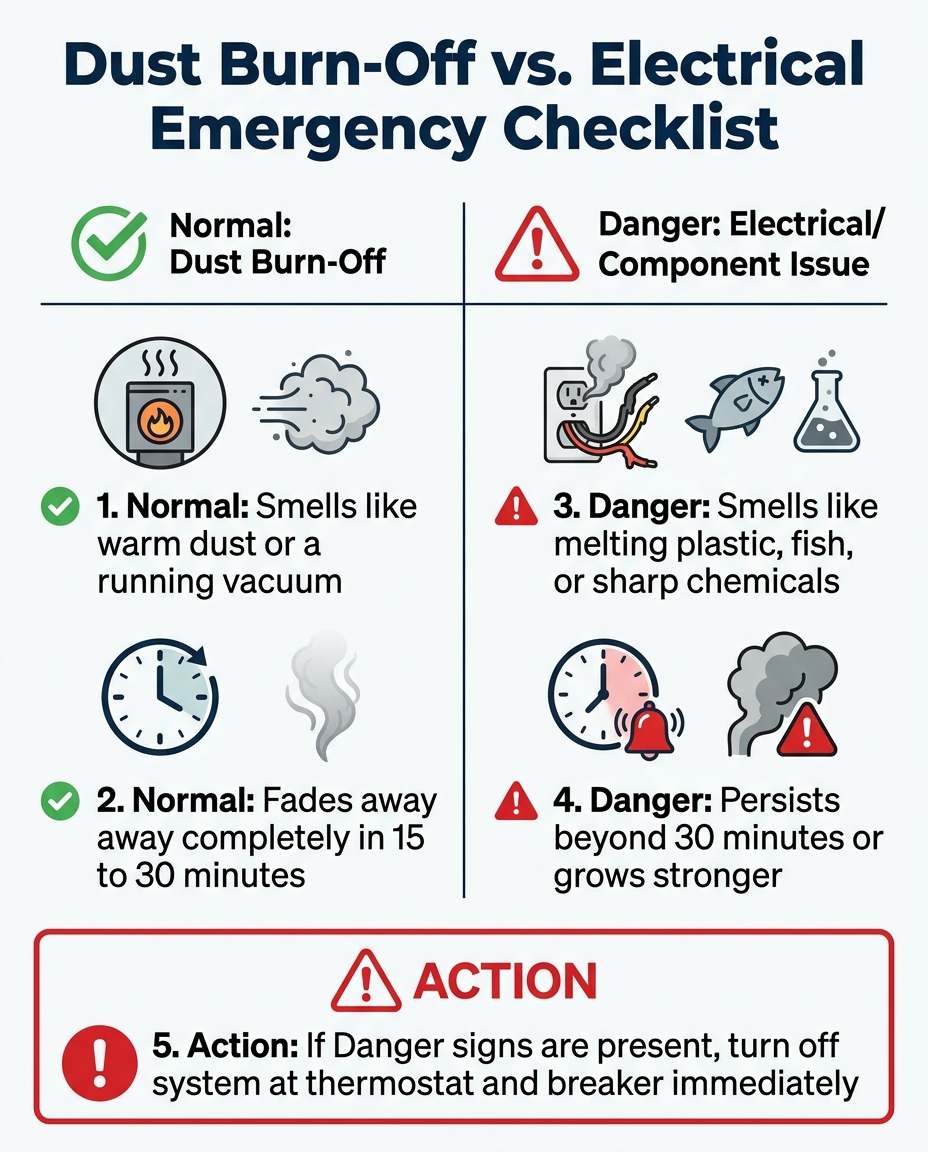
Industry standards and indoor air quality guidelines establish a strict 15 to 30 minutes as the normal duration for dust burn-off. From the moment warm air begins flowing from your vents, you should start a clock. During this window, the smell should peak within the first few minutes and then steadily dissipate as the dust is completely incinerated.
The ventilation strategy: If the smell is overwhelming but still smells strictly like warm dust, open a few windows and turn on your ceiling fans to help ventilate the harmless odor. If the smell persists beyond the 30-minute mark, or if the intensity of the odor increases rather than fades, you are no longer dealing with simple dust burn-off. At that point, the system requires professional evaluation.
Why Cochise County's Climate Amplifies Fall HVAC Odors
Homeowners in Benson AZ and surrounding Cochise County experience a much more intense fall heating startup than residents in milder, more humid climates. The unique geographic and meteorological realities of the high desert directly impact how your HVAC system behaves when the seasons change.
The Impact of Long, Dry Desert Summers
Benson's intense, prolonged summer heatwaves are accompanied by notoriously dry desert air. This lack of humidity means airborne dust remains suspended longer and travels further into your home's ductwork. Over six months of extreme cooling cycles, a significantly thicker layer of particulate matter settles heavily onto the dormant heating components.
• High particulate volume: Desert winds and summer monsoons push fine silt and sand into homes, much of which bypasses standard air filters.
• Extended dormancy: Because our summers last so long, the heating elements have a much longer window to collect debris compared to regions with shorter cooling seasons.
• Dry combustion: The extreme lack of moisture in the air causes the accumulated dust to burn off faster and more sharply, creating a stronger initial odor.
October Temperature Drops in Southern Arizona
The transition from summer to fall in Southern Arizona is rarely gradual. October brings sudden, significant nighttime temperature drops that catch many homeowners off guard. After months of running the AC around the clock, the sudden chill prompts widespread, simultaneous initial heating system startups across the entire region.
This abrupt shift forces HVAC systems to switch operational modes overnight. Because the transition is so sudden, homeowners rarely have time to prep their systems, meaning the accumulated summer dust is burned off all at once during that first cold night. Understanding this regional phenomenon helps explain why the initial fall burn-off smell is so pronounced here.
Dust vs. Danger: When to Shut Off Your Heating System Immediately
While dust burn-off is a localized nuisance, actual mechanical or electrical failures pose a severe threat to your property. Distinguishing between normal seasonal smells and dangerous electrical hazards is a critical skill for every homeowner.
Recognizing Electrical and Plastic Smells
A dangerous HVAC odor is distinctly different from the smell of burning dust. If your system is experiencing a critical failure, the resulting smells will be acrid, toxic, and highly unnatural. You should never ignore these warning signs.
• Melting plastic: Smells like a burning synthetic material. This often indicates melting wire insulation, a failing capacitor, or a severely overheating blower motor.
• Electrical ozone: Often described as a sharp, fishy, or chemical odor. This is a primary indicator of electrical arcing, short circuits, or melting circuit boards.
• Burning rubber: Usually points to a slipping or degrading fan belt in older units, or a seized motor bearing generating extreme friction.
• Smells like a dusty vacuum cleaner — Likely Cause: Normal summer dust burn-off — Required Action: Monitor for 15 to 30 minutes; open windows.
• Smells like melting plastic or fish — Likely Cause: Electrical short or melting insulation — Required Action: Shut off system immediately and call a professional.
• Smell persists longer than 30 minutes — Likely Cause: Trapped debris or failing component — Required Action: Shut off system; do not run until inspected.
• Visible smoke coming from vents — Likely Cause: Active combustion or severe motor failure — Required Action: Evacuate, shut off breaker, call emergency services if fire is suspected.
Immediate Safety Protocol for Homeowners
If you detect any of the dangerous odors listed above, you must take immediate action to protect your home. First, turn off the heating system directly at the thermostat. Next, locate your home's main electrical panel and flip the dedicated breaker for the HVAC system to the "off" position to completely sever the power supply.
Crucial safety warning: Do not attempt to open the air handler cabinet, dismantle the blower assembly, or inspect the high-voltage wiring yourself. Diagnosing and repairing electrical odors requires specialized diagnostic tools and a licensed professional. DIY electrical work on a 240-volt HVAC system is incredibly dangerous and can easily void your manufacturer's warranty.

How Routine Care Prevents Startup Smells in Heat Pumps and Furnaces
The most effective way to handle fall startup odors is to prevent them from happening in the first place. Proactive, professional care minimizes seasonal startup issues, improves your indoor air quality, and ensures your system transitions smoothly into the heating season.
The Role of Clean Air Filters
Your air filter is the first line of defense against desert dust. A clogged, dirty filter forces the blower motor to work harder and allows smaller particulates to bypass the media, pushing heavy dust directly onto the heating elements.
1. Check the filter monthly: During the dusty Benson summer, visually inspect your filter every 30 days.
2. Replace before startup: Always install a brand-new, high-quality pleated filter a few days before you anticipate turning on the heater for the first time.
3. Monitor airflow: Ensure all return vents are unblocked by furniture or rugs to maintain proper systemic airflow.
Professional Coil and Exchanger Cleaning
While changing filters is a homeowner's responsibility, deep cleaning the internal components requires professional expertise. Scheduling routine AC maintenance in the early fall allows a licensed technician to open the cabinet and safely clean the heat exchanger, electric strips, and blower assembly.
By physically removing the accumulated summer desert dust before the first freeze hits, the technician eliminates the source of the burning smell. Whether you rely on a gas furnace or an electric heat pump, this pre-season cleaning is critical for maintaining high indoor air quality and preventing unnecessary wear on the system.
Transitioning Seasons: From Extreme Cooling to Fall Heating
It is easy to forget the immense strain placed on your HVAC system during a prolonged Arizona summer. By the time October arrives, the equipment has already endured thousands of hours of high-stress operation, making the transition to heating a vulnerable time for internal components.
Summer Wear and Tear on Dual-Purpose Systems
Heat pumps are incredibly popular in Cochise County because they handle both extreme cooling and efficient heating. However, this means they experience year-round wear and tear. The same blower motor, compressor, and electrical relays that fought off the July heatwaves are now being asked to reverse their operation for the fall chill.
Components stressed during the summer can easily fail during this transition. For example, understanding why your AC capacitor failed in the summer can shed light on why your system might struggle to start the heating cycle in October. The electrical load of switching modes often pushes weakened parts past their breaking point.
When Startup Smells Indicate a Failing System
If your older HVAC system consistently struggles to transition between seasons, or if it produces persistent electrical smells every time it cycles on, a simple cleaning will not solve the problem. A burning rubber smell might indicate a blower motor that has been permanently damaged by summer heat stress.
When internal components begin to melt, arc, or seize, continuing to operate the system becomes a safety hazard. If a technician determines that the heat exchanger is cracked or the internal wiring is compromised, it may be time to consider a modern, energy-efficient AC installation to ensure your home remains safe and comfortable through the winter.
Common Homeowner Questions Answered: Troubleshooting Fall Heating Smells
When the temperature drops and the heater kicks on, local homeowners frequently search for quick, reliable answers. Here is a breakdown of the most common homeowner questions answered regarding fall heating startup.
Why does my heater smell like it's burning?
Your heater smells like it is burning because accumulated dust and debris are combusting on the internal heating elements. After sitting idle all summer, the system collects a layer of household dust. When the heat strips or furnace burners ignite for the first time, they rapidly heat up and incinerate that dust, pushing the resulting odor through your vents.
How long does a heater smell like burning dust?
A heater will typically smell like burning dust for 15 to 30 minutes after the initial startup. The smell should be strongest during the first five minutes and steadily dissipate as the dust burns away. If the odor continues past the 30-minute mark, you should turn the system off and schedule an inspection.
Is it safe to run the heater if it smells like burning?
It is safe to run the heater if the smell is strictly limited to warm, burning dust and fades within 30 minutes. However, if the smell resembles melting plastic, electrical ozone, or burning rubber, it is not safe to run the system. These odors indicate a mechanical or electrical failure that requires immediate professional attention.
What does an electrical fire in a heater smell like?
An electrical fire in a heater smells sharp, acrid, and highly unnatural, often resembling melting plastic or a distinct "fishy" chemical odor. This smell is caused by melting wire insulation, failing capacitors, or overheating circuit boards. If you detect this smell, shut off the power at the breaker immediately.
Can a dirty air filter cause a burning smell during fall startup?
Yes, a dirty air filter can significantly worsen a burning smell during fall startup. A clogged filter restricts airflow, causing the system to run hotter than normal, and allows excess dust to bypass the media and settle directly onto the heating elements. Replacing the filter before turning on the heat reduces this excess dust.
Do heat pumps produce the same startup smells as gas furnaces?
Yes, heat pumps produce the same burning dust smells as gas furnaces when their auxiliary electric heat strips activate for the first time. Even though heat pumps do not use combustion burners, the electric resistance coils get hot enough to incinerate the dust that has settled on them over the summer.
Get Professional Reassurance for Your Benson Home's HVAC System
Having your common homeowner questions answered is the first step in protecting your home, but nothing replaces the peace of mind that comes from a professional evaluation. While 15 to 30 minutes of burning dust smell is a completely normal part of the fall transition, you should never have to guess whether your system is safe to operate. If you are ever in doubt about a persistent odor, strange noise, or struggling system, our local experts are ready to help. Reach out to schedule a thorough heating inspection, and let us ensure your Benson home stays safely and reliably comfortable all season long.
Other Blogs

•WHY US
Why Homeowners Choose Us for custom HVAC work
Ann N.
While it was expensive to replace my HVAC I loved with with and They delivered when promised and were very diligent about making sure I understood how the system operated. The knowledge level was SO MUCH HIGHER than anyone else I had received a quote from. I would highly recommend them for HVAC replacement.
Ed T.
americanairaz was very professional and did a thorough job on the installation as well as the annual maintenance check. I would highly recommend All American Air to anyone.
Renaye F.
Great service, professional and affordable company. Very knowledgeable and also took the time to explain everything in detail. Which I appreciated very much. Would definitely recommend.
John C.
First class shop. Very clean install ,would recommend to a friend. Excellent equipment,Mitsubishi is number one in industry.and most efficient seer rating.thank you

Read More Blogs
Explore the world of creative writing and discover how words can paint vivid pictures in the minds of readers.