

A Sudden August Breakdown: Why Your AC Quit When You Needed It Most
The late August monsoon season is fully underway here in Benson, AZ, and your air conditioner has been running non-stop since May. It survived the scorching early summer dry heat without a hitch, keeping your home comfortable through the worst of the triple-digit days. But now, just as the season starts winding down, the system suddenly shuts off. The house is warming up fast, and you are left wondering exactly why your AC capacitor failed in August after surviving the June heatwave. A sudden breakdown right now can easily cause panic. When the outdoor unit stops humming and the indoor vents start blowing warm air, it is easy to assume the entire system has reached the end of its lifespan.
The reality is usually much less severe. Over the course of a long Arizona summer, cumulative weather stress takes a hidden toll on the electrical components inside your condenser. What looks like a random, catastrophic failure is often just a localized electrical issue that has been brewing for months. The components inside your air conditioning system do not operate in a vacuum; they are constantly battling the extreme environmental conditions outside your home. When a specific part like a capacitor finally gives out, it is rarely a surprise to the professionals who understand the local climate.
If you are currently sitting in a hot house, you need fast access to reliable air conditioning services to diagnose the problem accurately. Fortunately, getting prompt AC repair in Benson can isolate the faulty component, replace it safely, and get your cooling restored before the house becomes unbearable. Understanding why this specific failure happens will help you realize that your system is likely not dead—it just needs a very common, weather-related intervention.
What Does an AC Capacitor Actually Do?
To understand why this specific part fails so frequently in late summer, you have to understand what it actually does. The AC capacitor is a small, cylindrical electrical component located inside the metal cabinet of your outdoor condensing unit. Its primary job is to store electrical energy and deliver a powerful jolt to jump-start the heavy motors inside the system. Without a functioning capacitor, the massive compressor motor simply cannot overcome its own inertia to begin pumping refrigerant.
Think of the capacitor's role through these common analogies:
• The high-powered battery: Much like a car battery provides the initial surge of power to turn over a heavy engine, the capacitor provides the torque needed to start the compressor and the outdoor fan motor from a dead stop.
• The continuous power stabilizer: Once the motors are running, a specific type of capacitor continues to supply a steady, even flow of electrical current. This keeps the motors spinning efficiently without drawing massive, fluctuating amounts of power directly from your home's electrical grid.
• The heavy lifter: Every single time your thermostat calls for cooling, the capacitor goes to work. During the peak of a Benson AZ summer, this means the capacitor is charging and discharging thousands of times a month, bearing the brunt of the electrical workload.
Because this component handles such massive amounts of high-voltage electricity, it is inherently sensitive to external environmental extremes. When you look at the different types of HVAC systems on the market today, almost all traditional split systems rely heavily on these capacitors to function. They are the gatekeepers of your cooling power.
Types of Capacitors and Their Workloads
Not all capacitors do exactly the same job. Depending on your specific air conditioning unit, you may have multiple capacitors or one large unit handling several tasks. Here is a breakdown of how they function under pressure:
• Start Capacitor — Primary Function: Provides the massive initial jolt of energy (torque) needed to get the compressor motor spinning. — How Heat Affects It: Extreme temperatures can cause the internal fluid to expand rapidly, leading to physical bulging or casing rupture.
• Run Capacitor — Primary Function: Maintains a continuous, even flow of electrical current to keep the motors running smoothly once started. — How Heat Affects It: Prolonged heat degrades the internal insulation, causing electrical current fluctuations that force the motor to overwork.
• Dual Run Capacitor — Primary Function: Combines both functions into a single unit, supporting both the compressor and the outdoor fan motor simultaneously. — How Heat Affects It: Because it handles double the workload in a single housing, it is highly susceptible to thermal breakdown during extended heatwaves.
The Silent Damage: Surviving the June Heatwave
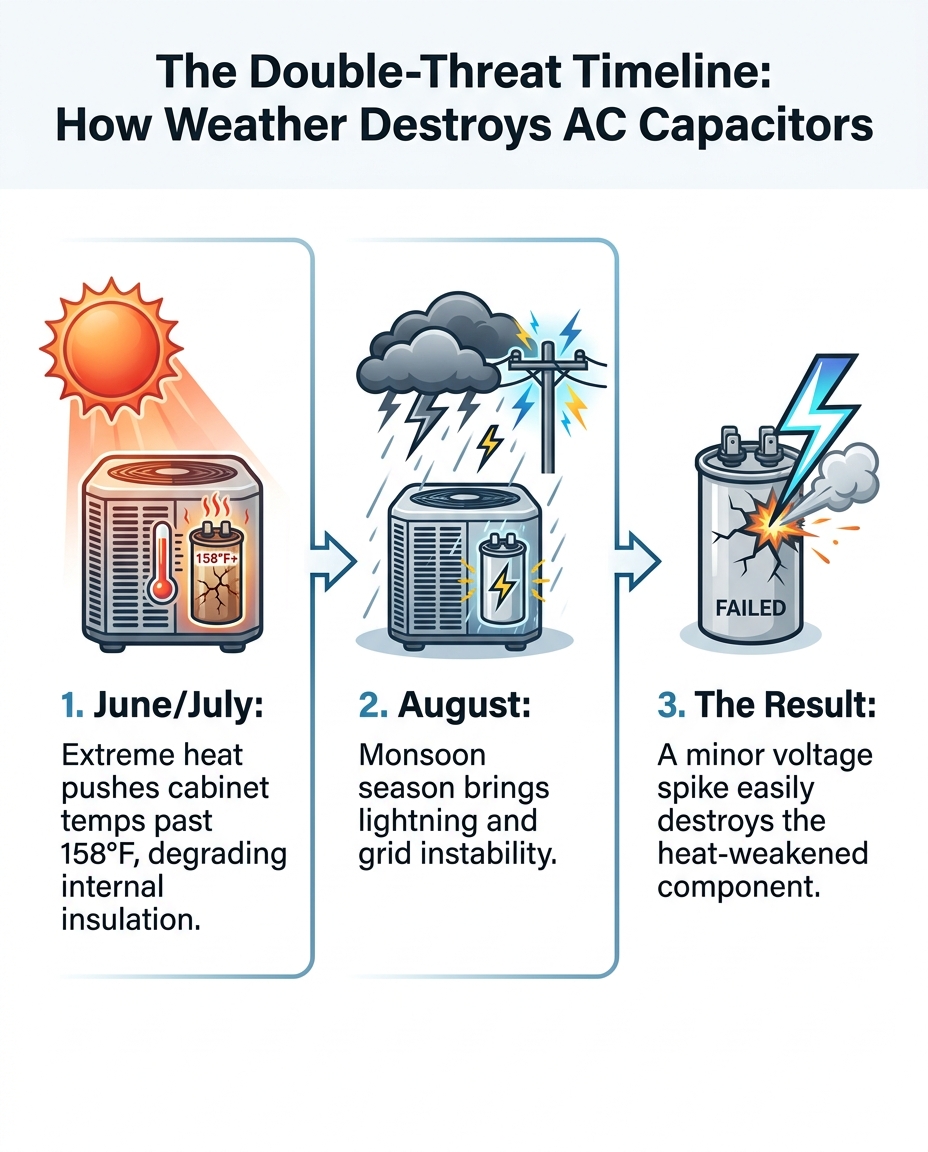
The story of a late August AC failure actually begins months earlier. During June and July, Benson experiences intense, dry heat. The sun beats down continuously on the metal cabinet of your outdoor condenser from sunrise to sunset. This environmental reality sets the stage for the first half of a devastating double-threat to your system's electrical components.
Most standard AC capacitors are rated by manufacturers to withstand operating temperatures up to roughly 158 degrees Fahrenheit. That might sound incredibly high, but consider the operational environment. The ambient outside air temperature might be 105 degrees. The metal box is sitting in direct, unfiltered sunlight, acting like an oven. Inside that box, the massive compressor motor is generating its own intense mechanical heat as it runs for hours on end. Very quickly, the temperature inside the condenser cabinet can surpass that 158-degree threshold, pushing the electrical components far beyond their engineered limits.
Thermal Degradation Explained
When a capacitor operates in an environment that exceeds its maximum temperature rating, it undergoes a destructive process called thermal degradation. Inside the metal cylinder of the capacitor, there are thin layers of insulating material and a specialized dielectric fluid. Prolonged exposure to extreme heat literally bakes these internal components.
The constant heat alters the chemical composition of the dielectric fluid, causing it to lose its ability to store an electrical charge efficiently. As the fluid degrades, it can begin to boil, creating internal gas pressure. To prevent an explosion, capacitors are designed with a safety mechanism that allows the top of the cylinder to expand or "mushroom" upward, which safely breaks the internal electrical connection. Even if it does not pop immediately, the internal insulation begins to dry out and break down.
The capacitor did not truly survive the June heatwave completely unscathed. Instead, it accumulated invisible wear and tear. It lost structural integrity and electrical capacity, operating on borrowed time while struggling to provide the same amount of starting torque to the compressor. It was silently weakening, waiting for a final push to push it over the edge.
The Final Blow: How Late-Summer Monsoons Trigger Failure
By the time August rolls around, your AC capacitor is tired. Its internal insulation is compromised, and its dielectric fluid is severely degraded. Then, the weather pattern shifts dramatically. The dry, baking heat gives way to the late August monsoon season. This transition brings heavy storms, intense lightning, and highly erratic electrical grid behavior.
As a local service provider with deep knowledge of Benson AZ's specific climate challenges, one pattern we see constantly is the direct correlation between late-summer storms and sudden electrical component failures. The transition from extreme dry heat to wet, electrically charged storms creates a unique "perfect storm" for HVAC systems.
When a monsoon rolls through, it often causes sudden voltage fluctuations, brownouts, and power surges. A lightning strike miles away can send a spike of excess voltage through the local power grid, down your street, and directly into your home's electrical panel. Even minor grid instability during a heavy rainstorm forces your air conditioner to handle unstable electrical currents.
Here is where the two threats combine into a critical failure. If a brand-new capacitor receives a minor power surge, its robust internal insulation can usually handle the spike without failing. But your capacitor's insulation was already baked and broken down by the June heatwave. When the August power surge hits that weakened insulation, it instantly arcs, short-circuits, and blows the component entirely. The storm was simply the catalyst that finished off a part already heavily damaged by cumulative thermal stress.

Identifying the Symptoms of a Blown Capacitor
When the capacitor finally gives out, the signs are usually immediate and highly specific. Because this part is responsible for starting the heavy motors, a failure means the motors cannot run, even though the system is receiving power from your indoor thermostat. Knowing what to look for can help you communicate clearly with your technician and avoid further damage.
Here are the most common symptoms that indicate you are dealing with a blown capacitor:
• A distinct humming or clicking noise: You might hear a loud buzzing or humming sound coming from the outdoor unit. This is the compressor motor trying to start but lacking the electrical torque to actually turn over.
• The outdoor fan will not spin: You can hear the system trying to run, but the large fan blades on the top of the outdoor condenser remain completely stationary.
• Warm air blowing from the vents: Because the outdoor compressor is not engaging, the system cannot pump refrigerant through the lines. The indoor blower motor will still run, but it will only circulate room-temperature air through your ductwork.
• Repeatedly tripping the circuit breaker: A failing capacitor can cause the compressor to pull far too much amperage as it struggles to start. This excess electrical draw will trip your home's electrical breaker as a built-in safety precaution.
Immediate Steps to Protect Your System
If you notice any of these signs, taking immediate action is critical. Forcing the system to keep trying to start with a bad capacitor will eventually burn out the compressor motor itself, turning a minor repair into a major replacement. Keeping up with routine AC maintenance can often catch weakened capacitors before they blow, but once these symptoms appear, you must act quickly:
1. Turn off the thermostat: Switch your indoor thermostat to the "off" position immediately to stop the system from attempting to draw power.
2. Check the electrical panel: Inspect your home's main electrical panel to see if the dedicated breaker for the AC has tripped.
3. Do not force a reset: If the breaker is tripped, you can attempt to reset it exactly once. If it trips again immediately, do not force it back on. This is a clear sign of an active electrical short.
4. Wait for a professional: Leave the system off and contact a licensed technician to safely test the electrical components.
Don't Panic: Why This is a Routine Professional Fix
Hearing your air conditioner struggle and then completely shut down during the late August monsoon season is incredibly stressful. The immediate fear is that the entire system has failed and requires a massive investment to replace. However, it is vital to remember that a blown capacitor does not mean your entire air conditioning system is dead.
In fact, replacing a capacitor is one of the most standard, straightforward repairs our technicians perform across the Benson service area during late summer. It is a highly localized fix that simply involves diagnosing the specific electrical failure and swapping out the damaged cylinder for a new one with the exact correct microfarad rating.
A strict warning against DIY replacement:
While the repair is routine for a professional, it is extremely dangerous for a homeowner to attempt. Capacitors are literally designed to store massive amounts of high-voltage electricity. Even when you turn off the power at the main circuit breaker and pull the outdoor disconnect whip, the capacitor can still hold a lethal electrical charge for a significant amount of time.
Handling a capacitor without the proper training, protective gear, and specialized tools to safely discharge it first can result in severe electrical shock. Furthermore, installing a capacitor with the wrong voltage or capacitance rating will permanently damage your compressor motor. A licensed technician uses a specialized digital multimeter to measure the exact microfarads (µF) the capacitor is producing. If a part is rated for 35 µF and reads below 31 µF, the technician knows it has failed and can safely discharge and replace it. Always rely on a licensed local professional who understands the specific regional weather impacts to handle this critical component.
Frequently Asked Questions About Summer AC Capacitor Failures
Can extreme summer heat alone cause an AC capacitor to fail?
Yes, prolonged exposure to temperatures above the capacitor's rating breaks down its internal insulation over time. When the ambient temperature is over 100 degrees, the temperature inside the metal condenser cabinet can easily exceed the 158-degree maximum rating of standard capacitors. This constant baking alters the chemical composition of the internal dielectric fluid. Over weeks of exposure, the fluid degrades and the insulation dries out, significantly reducing the component's ability to store and deliver an electrical charge.
How do power surges from summer storms affect air conditioners?
Surges force excess voltage through the system, instantly frying electrical components that may already be weakened from prior heat stress. During a monsoon storm, lightning strikes and grid fluctuations send sudden spikes of electricity through your home's wiring. If your AC capacitor has already suffered thermal degradation from the early summer heat, its internal insulation is too weak to resist the spike. The surge arcs across the weakened insulation, creating a short circuit that permanently destroys the capacitor.
Why is my AC suddenly blowing warm air after a monsoon?
A storm-induced power surge likely blew the capacitor, preventing the outdoor compressor from turning on to cool the refrigerant. Without a functioning capacitor, the massive compressor motor lacks the electrical torque needed to start. However, your indoor blower motor operates on a separate circuit and may continue to run. As a result, the indoor fan pushes uncooled, room-temperature air through your ductwork, making it feel like the AC is running but failing to cool the house.
How do I know if my AC capacitor is blown?
Look for a humming condenser unit, a fan that won't spin, or a visually bulging capacitor (inspected only by a pro). You will typically hear the outdoor unit buzzing as the motor tries and fails to start. You may also notice that the indoor vents are blowing warm air, or that the system repeatedly trips your home's circuit breaker. A professional technician will often find that the top of the capacitor has physically expanded or "mushroomed" upward, which is a built-in safety mechanism to prevent the overheated component from exploding.
Can I replace my AC capacitor myself?
No. Capacitors store dangerous amounts of electrical charge even when disconnected from the grid, requiring a licensed professional for safe handling. Even if you turn off the power at the breaker panel and remove the outdoor disconnect switch, the capacitor acts like a battery and retains high voltage. Touching the terminals without properly discharging the unit can cause severe injury. Additionally, installing a capacitor with an incorrect microfarad rating will cause permanent, expensive damage to your compressor motor.
Restore Your Cooling Before the Next Late-Summer Storm
Late summer weather in Southern Arizona is highly unpredictable, and reliable cooling remains an absolute necessity well into the fall months. If your system has suddenly stopped blowing cold air after a monsoon storm, do not wait for the problem to resolve itself. A blown capacitor requires prompt professional attention to protect the rest of your HVAC equipment from severe electrical strain.
Schedule an immediate diagnostic with a licensed professional to safely test your electrical components, replace any heat-damaged parts, and get your home comfortable again. Understanding that a failed capacitor is a common, localized result of monsoon power surges and cumulative heat provides peace of mind that you likely just need a straightforward repair. Reach out to local experts today to safely restore your cooling and ensure your system is ready to handle whatever the rest of the season brings.
Other Blogs

•WHY US
Why Homeowners Choose Us for custom HVAC work
Ann N.
While it was expensive to replace my HVAC I loved with with and They delivered when promised and were very diligent about making sure I understood how the system operated. The knowledge level was SO MUCH HIGHER than anyone else I had received a quote from. I would highly recommend them for HVAC replacement.
Ed T.
americanairaz was very professional and did a thorough job on the installation as well as the annual maintenance check. I would highly recommend All American Air to anyone.
Renaye F.
Great service, professional and affordable company. Very knowledgeable and also took the time to explain everything in detail. Which I appreciated very much. Would definitely recommend.
John C.
First class shop. Very clean install ,would recommend to a friend. Excellent equipment,Mitsubishi is number one in industry.and most efficient seer rating.thank you

Read More Blogs
Explore the world of creative writing and discover how words can paint vivid pictures in the minds of readers.