

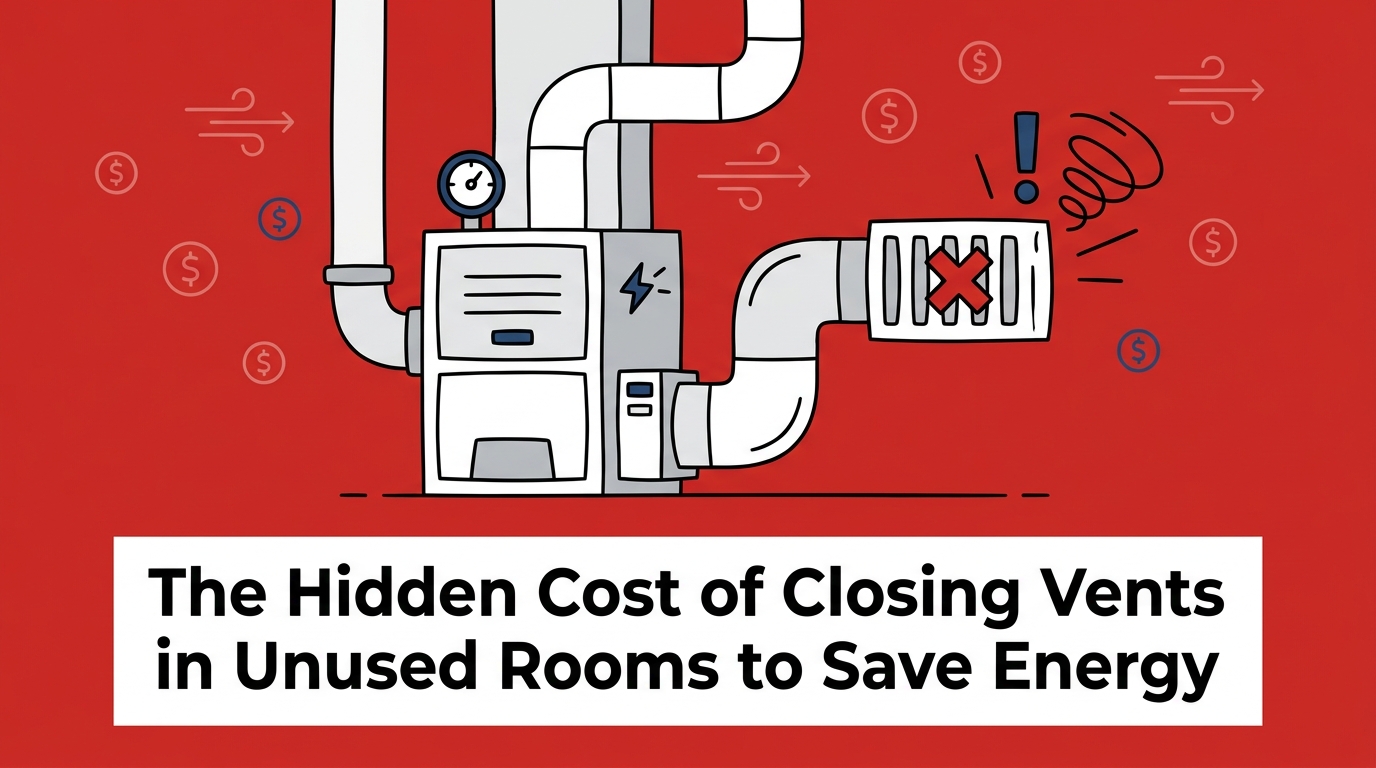

The Myth of Closing Vents to Save Energy
Closing registers in unused guest rooms does not cut down your cooling bills—in fact, the hidden cost of closing vents in unused rooms to save energy is often a catastrophic and expensive system breakdown. It sounds completely logical on the surface. If you are not using a spare bedroom, a home office, or a formal dining room, why pay to pump cold air into it? Many homeowners shut the floor or ceiling registers, assuming their air conditioner will simply redirect that extra cold air to the rooms they actually use, saving electricity in the process.
The reality is that modern central air conditioning networks do not operate like standard light switches. When you turn off a light bulb, you stop drawing electrical power. When you close an air register, your blower motor does not know you want less air. It continues pushing the exact same volume of air through a suddenly restricted pathway.
At All American Air, our team routinely responds to mid-summer service calls where this exact practice has dramatically altered the delicate airflow balance of an entire home. During peak summer loads, when your equipment is already running long cycles to combat the heat, this restriction creates a massive bottleneck. The air backs up, pressure builds, and the entire cooling process is thrown off balance. Instead of saving electricity, you force the system to work harder, run longer, and risk severe mechanical damage.
If you are concerned about the efficiency and longevity of your air conditioning system, understanding how airflow actually works is the first step toward real energy savings.
Understanding HVAC Static Pressure and Airflow Balance
To understand why shutting registers is harmful, you have to look at the basic physics of air distribution. HVAC professionals measure the resistance to airflow within your ductwork using a metric called static pressure. You can think of static pressure as the blood pressure of your home's air conditioner.
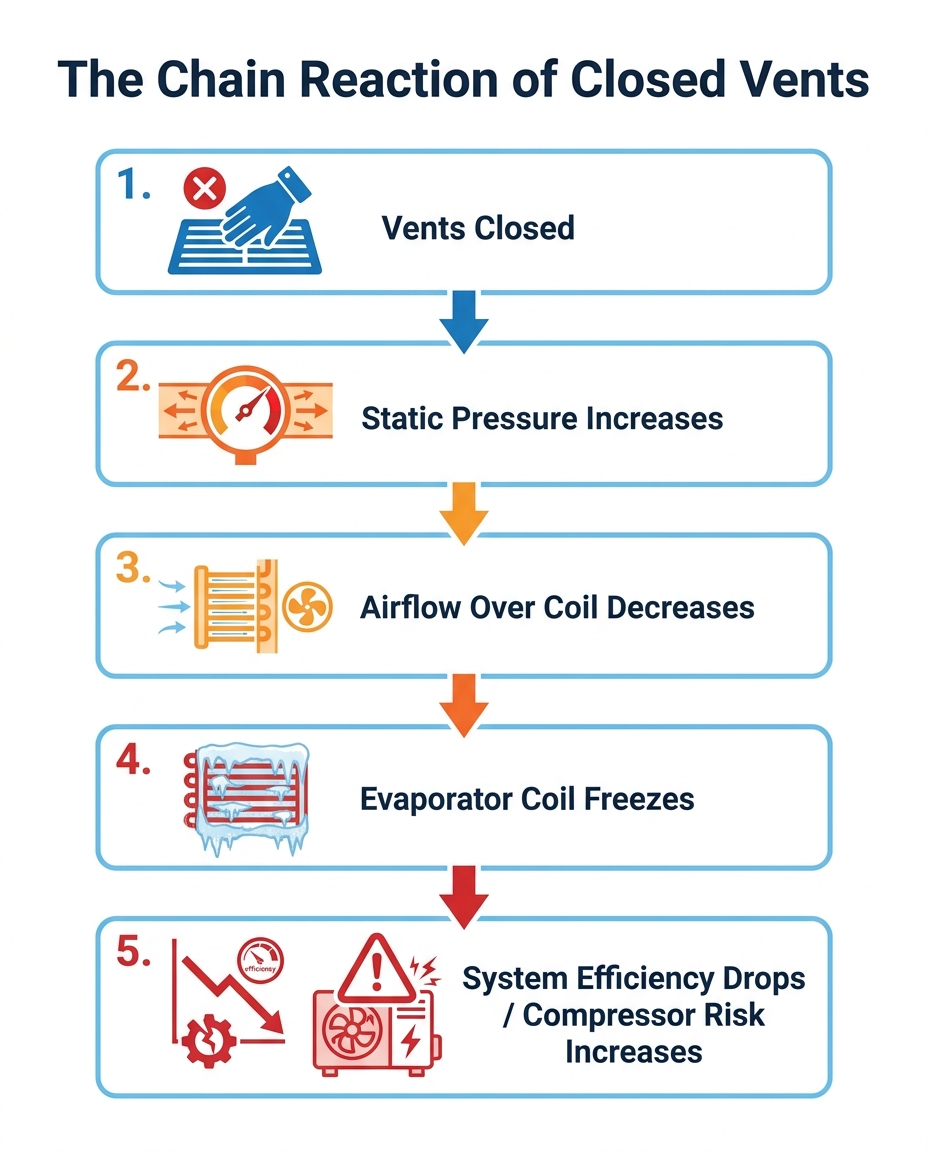
Your central air system is precisely engineered and balanced to move a specific volume of air, measured in Cubic Feet per Minute (CFM). The size of your blower motor, the width of your ductwork, and the number of vents in your home are all calculated to maintain a stable, healthy pressure. When you shut off a vent, you are not telling the blower to produce less air. You are simply forcing the same amount of air into a smaller distribution area. Just like blocking an artery causes blood pressure to spike, closing vents causes a dangerous spike in high static pressure.
When high static pressure occurs, your system immediately begins to struggle. You might notice whistling sounds coming from the remaining open vents, or you might feel a sudden rush of air that feels stronger than usual. These are warning signs that the system is choking on its own airflow.
How Blowers React to Resistance
The way your system responds to this increased pressure depends heavily on the type of blower motor installed inside your indoor unit. Neither outcome is good for your energy bills or the lifespan of the equipment.
• Standard (PSC) Motor — Reaction to Closed Vents: Pushes against the resistance but cannot overcome it, resulting in a drop in total airflow. — Resulting Consequence: Motor overheats, risking premature burnout and significantly reducing cooling capacity.
• Variable-Speed (ECM) Motor — Reaction to Closed Vents: Detects the resistance and automatically ramps up its RPMs to force the air through. — Resulting Consequence: Consumes massive amounts of electricity, entirely defeating the goal of saving energy.
Whether your motor burns out from overheating or ramps up and consumes excess power, the result is the same: you pay more. If you are curious about which type of motor you have, exploring the different types of HVAC systems can help you understand your equipment's specific vulnerabilities.
The Chain Reaction: From Closed Vents to Frozen Evaporator Coils
What happens when high pressure chokes the airflow? The first major component to suffer is the evaporator coil. In extreme Arizona summer heat, your system is already operating at maximum capacity to keep your home comfortable. It is highly susceptible to rapid freezing if airflow is restricted during peak summer loads.
Our technicians see this freezing process happen in a predictable, destructive sequence all over Benson:
1. The role of the evaporator coil: This A-shaped metal coil sits inside your indoor unit, filled with chilled liquid refrigerant. Its job is to absorb heat from the warm indoor air blowing across it.
2. Airflow restriction: When vents are closed, the volume of warm air returning to the unit drops significantly. The blower cannot push enough air over the coil.
3. Condensation freezing: Without enough warm air passing over the chilled metal, the temperature of the coil drops below freezing. The natural condensation that forms on the metal fins quickly turns to solid ice.
4. Complete cooling failure: The ice block grows rapidly, encasing the entire coil. This prevents any air from passing through at all. The cooling process completely stops, even though the outdoor unit is still running constantly.
5. Compressor danger: If the refrigerant does not absorb enough heat indoors, it remains a liquid instead of turning into a warm gas. This liquid refrigerant flows back outside to the compressor. Compressors are designed to pump gas, not liquid. This "liquid slugging" can destroy a compressor entirely, leading to a massive replacement bill.
A frozen coil is not a minor inconvenience; it is a major mechanical emergency. If you notice ice forming on your indoor unit or your refrigerant lines, shut the system off immediately and call for professional AC repair in Benson before the compressor fails.

The Impact of Duct Leakage in Extreme Heat
High static pressure does not just threaten the equipment; it actively wastes the cold air you are paying to generate. Most residential ductwork systems are not perfectly airtight. They have minor, often unnoticed leaks at the joints, seams, and connections. Under normal operating conditions, these small leaks result in a very minimal loss of air.
However, when you close vents, the resulting high static pressure looks for the path of least resistance. The air has to go somewhere. The elevated pressure forces your newly cooled, conditioned air out through these minor leaks and directly into unconditioned spaces like your attic, crawlspace, or inside your walls.
In our years of inspecting local homes, we know that Benson, AZ, attic temperatures can easily soar well above 130 degrees in July. Pumping your expensive cold air into a 130-degree attic is a massive waste of energy. The ductwork itself becomes pressurized, acting like a leaky balloon that is being squeezed too tightly.
Energy Waste vs. Energy Savings
The intended goal: You closed the vent to save energy and lower your monthly utility bill. The actual result: Because you are losing cold air to the attic, the living spaces receive less cooling. The thermostat does not reach its set temperature, forcing the system to run much longer cycles. Longer run cycles mean the outdoor unit is consuming electricity for hours on end, entirely defeating the original goal. You end up paying more money for a less comfortable home.
Secondary Consequences: Humidity and Indoor Air Quality
Temperature control is only one part of what your air conditioner does. Imbalanced airflow disrupts other critical functions, primarily dehumidification and air filtration. Your system relies on a steady flow of air to keep the indoor environment healthy.
• Loss of Dehumidification: Proper airflow is required for effective moisture removal. As warm air passes over the evaporator coil, moisture is pulled out and drained away. When airflow is choked during peak summer loads, the system cannot effectively dehumidify the air, leaving your home feeling sticky and uncomfortable.
• Reduced Filtration: Your HVAC filter relies on air passing through it to trap dust, pet dander, and allergens. Restricted airflow limits the total volume of air being cleaned per hour.
• Stagnant Air and Mold Risk: In the rooms where you closed the vents, the air becomes completely stagnant. Without proper circulation, these unused rooms become breeding grounds for localized humidity buildup. This can quickly lead to musty odors, mildew growth on windowsills, and poor overall air quality.
Your entire home operates as a single connected environment. Poor air quality in an unused guest bedroom will eventually bleed into the hallway and the rest of your living space. Keeping vents open ensures that the air is constantly moving, filtering, and dehumidifying. If you are struggling with stale air, evaluating your indoor air quality is a much safer approach than shutting off registers.
Professional Diagnostics vs. DIY Airflow Adjustments
The main takeaway for homeowners is simple: keep all supply and return vents fully open. Do not attempt to balance your home's temperature by shutting off registers in empty rooms. The risks of high static pressure, frozen coils, and compressor damage far outweigh the imaginary energy savings.
If you have rooms that are constantly too cold or too hot, closing vents is a band-aid that causes more harm than good. These temperature imbalances usually indicate a fundamental duct design issue, inadequate insulation, or a system balancing problem that requires a closer look.
This is where our professional diagnostic expertise becomes invaluable. When the All American Air team inspects your system, we don't guess at airflow; we use specialized tools like digital manometers to measure static pressure accurately. We can identify airflow imbalances, pinpoint duct leaks, and resolve underlying issues safely before they cause catastrophic system failure. If you truly want different temperatures in different rooms, our professionals can install a dedicated HVAC zoning system with motorized bypass dampers, or add a ductless mini-split for that specific room.
Before you start shutting vents this summer, schedule routine AC maintenance. A professional assessment will give you the clear, authoritative explanation you need to keep your system running efficiently, ensuring you stay comfortable without damaging your equipment.
Frequently Asked Questions
Does closing vents in unused rooms save money?
No, it generally increases your energy costs. Closing vents raises static pressure, which forces the blower motor to work harder and pushes conditioned air out of duct leaks. This causes your system to run longer cycles, consuming more electricity rather than less.
Why do AC coils freeze when vents are closed?
The evaporator coil relies on a steady flow of warm indoor air to keep it from dropping below freezing. When vents are closed, airflow is restricted, and the coil gets too cold. The natural condensation on the coil freezes into solid ice, blocking airflow entirely.
What is HVAC static pressure?
Static pressure is the measurement of resistance to airflow within your ductwork system. Think of it like blood pressure for your HVAC unit. When static pressure is too high—often caused by closed vents or dirty filters—the system struggles to push air through, leading to severe mechanical strain.
Can closing vents damage your AC compressor?
Yes, severely restricted airflow can destroy a compressor. If the evaporator coil freezes, the refrigerant cannot absorb heat and remains in a liquid state. When this liquid flows back to the outdoor compressor—a process called liquid slugging—it can cause catastrophic mechanical failure.
How many vents can I close safely?
HVAC professionals strongly recommend keeping 100 percent of your supply and return vents fully open. The system is engineered and balanced for a specific volume of air. Closing even one or two vents alters this balance, increasing static pressure and straining the equipment.
What should I do if one room is constantly too cold?
If a specific room is always colder than the rest of the house, do not close the vent. Instead, have a professional evaluate your ductwork for proper balancing. Solutions may include installing a dedicated zoning system, adjusting the duct design, or adding a ductless mini-split for customized control.
Other Blogs

•WHY US
Why Homeowners Choose Us for custom HVAC work
Ann N.
While it was expensive to replace my HVAC I loved with with and They delivered when promised and were very diligent about making sure I understood how the system operated. The knowledge level was SO MUCH HIGHER than anyone else I had received a quote from. I would highly recommend them for HVAC replacement.
Ed T.
americanairaz was very professional and did a thorough job on the installation as well as the annual maintenance check. I would highly recommend All American Air to anyone.
Renaye F.
Great service, professional and affordable company. Very knowledgeable and also took the time to explain everything in detail. Which I appreciated very much. Would definitely recommend.
John C.
First class shop. Very clean install ,would recommend to a friend. Excellent equipment,Mitsubishi is number one in industry.and most efficient seer rating.thank you

Read More Blogs
Explore the world of creative writing and discover how words can paint vivid pictures in the minds of readers.